
Why Cleaning and Oiling is Not Enough to Keep a Clock Running
We’ve all been there. You purchase a used clock—or inherit one from a family member—and when you finally set it in motion, it won’t stay running. You take a look at the movement, notice that it appears a bit dirty, and decide to clean and oil it. Unfortunately, after all that effort, the clock still stops after running for only a short time.
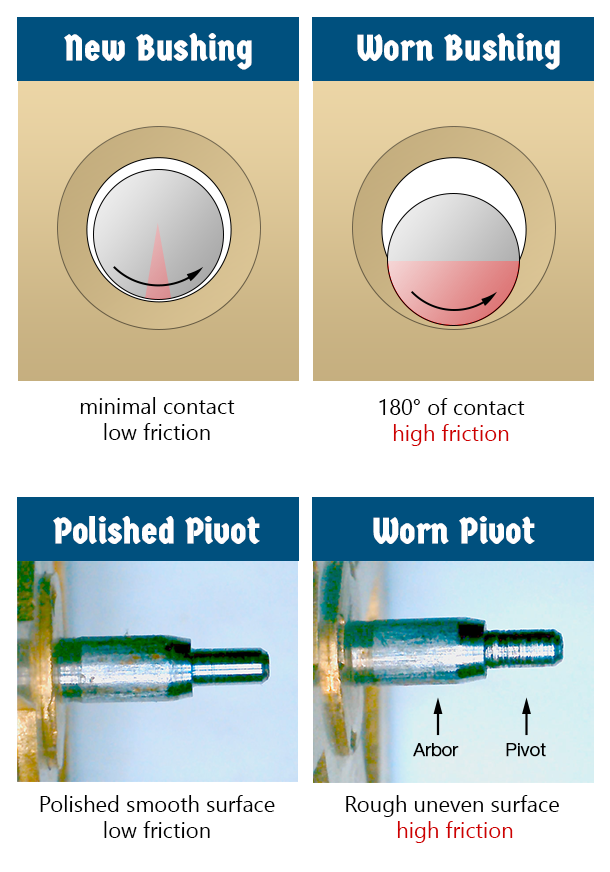
The hard truth is that, like anything mechanical, clocks do not last forever without proper maintenance and repair. Decades of wheels turning and parts moving take their toll. Wear develops gradually and invisibly, and once it reaches a certain point, cleaning and oiling alone are no longer enough to keep the clock running reliably.
As a clock operates, friction is constantly at work. The steel pivots (the ends of the wheel arbors) rotate in holes—or bushings—in the brass plates. Over time, this friction slowly removes material from the plates and bushings, enlarging and deforming the pivot holes. Meanwhile, the oil that was originally applied begins to break down. It attracts dust, thickens, and eventually forms a gritty, abrasive paste that actually accelerates wear instead of preventing it. Once the oil has completely dried or gummed up, there is effectively no lubrication left at all.
The damage doesn’t stop there. As the clock continues to run under these conditions, the pivots themselves begin to wear. What was once a smooth, mirror-polished surface becomes rough and uneven. This dramatically increases friction and raises the amount of power required to turn each wheel. Eventually, the clock no longer has enough energy to overcome this resistance, and it stops.
Clocks, like all machines with moving parts, are meant to be serviced periodically to correct these issues. At a minimum, proper servicing typically involves fully disassembling the movement, cleaning it with appropriate solutions, polishing the pivots, and installing new brass or bronze bushings to replace the material that has been worn away from the plates. Once this work is completed—and assuming no other problems are present—the movement is reassembled, lubricated with specialized horological grade oils, adjusted, and thoroughly tested.
This process is time-consuming and requires specialized tools, training, and experience. For that reason, it is generally work best left to a horologist, or professional clock repairer. While cleaning and oiling are important parts of clock maintenance, they are only one piece of a much larger puzzle when it comes to restoring a clock to reliable, long-term operation.