
About CuckooCatalog.com
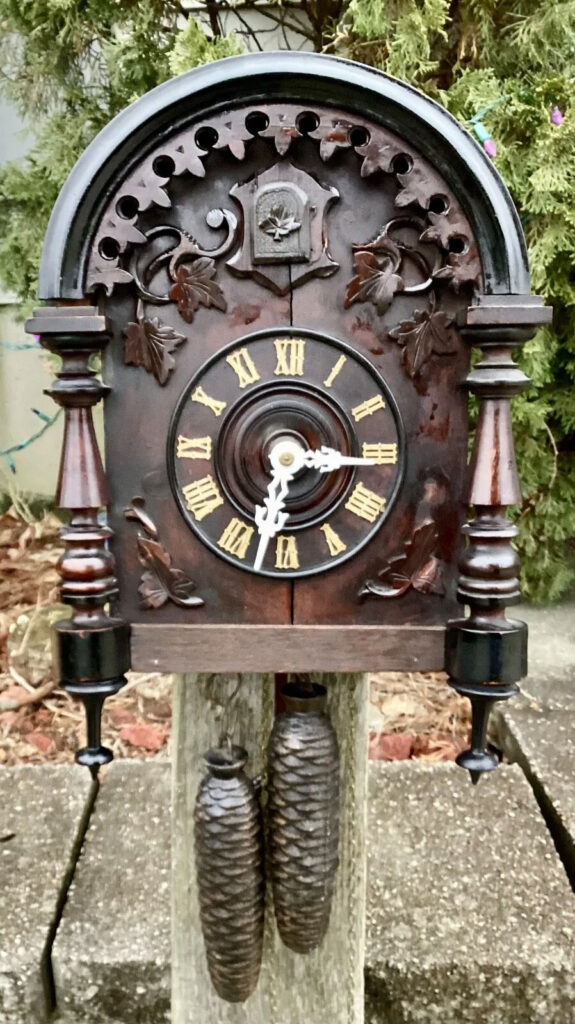
Shortly after I began collecting clocks, I came across a cuckoo clock by Gordian Hettich & Söhne (GHS) with an arched top. The clock was in need of restoration, missing its top piece and the so-called skirt, but I was immediately fascinated by its uniqueness. I wanted to restore it as accurately as possible without compromising its historical integrity. This clock was the beginning of everything. (Fig. 1)
Out of curiosity, I began searching online for catalogs from Gordian Hettich & Söhne (GHS), hoping to find a reference clock as a basis for my restoration. I assumed someone, somewhere, must have published a catalog online, but despite countless hours of searching, I found nothing. A few catalogs turned up here and there—a Beha catalog with poor quality images, a Philipp Haas & Söhne catalog—but nothing from GHS.
Frustrated by the lack of information, my search turned into a new passion: I began collecting as many historical cuckoo clock catalogs as I could find—not only to preserve them, but also to share them. I realized how helpful they could be for enthusiasts like myself who were missing case parts or pendulums, or who simply wanted to learn more about the origin of their clocks.
It made no sense to me that these rare historical documents were locked away in archives, private collections, or long out-of-print publications, and completely inaccessible to the average collector.
As my collection of catalogs grew, I often helped others identify their clocks. In Facebook groups, users would post photos of newly acquired cuckoo clocks asking for help identifying the manufacturer or dating the piece. I did my best to search through the catalogs in my growing library to find a match. But with the increasing number of catalogs, the time required to search grew as well—especially when the clocks had no identifying features.
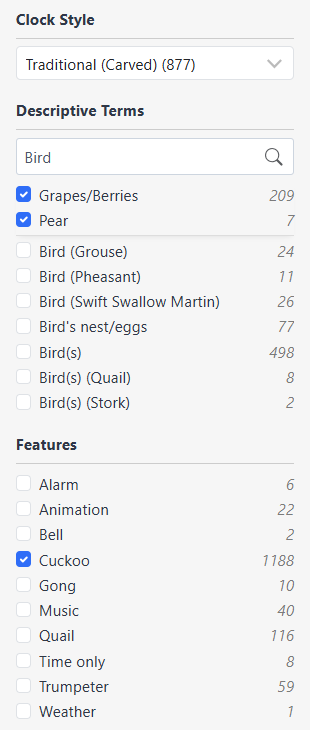
It became clear: there had to be a more effective way. Collectors needed a tool to search these catalogs themselves. It was neither efficient nor sustainable for me to remain the only point of contact for this growing archive. I envisioned a searchable online system where users could enter visual features of their clock—like “oak leaves” or “eagle”—to find similar clocks in authentic historical catalogs.
As a trained web developer, I realized I could build such a system. And so, this website was born.
What Does CuckooCatalog.com Offer?
CuckooCatalog.com is a searchable online archive of antique and vintage cuckoo clock catalogs. It allows users to filter clocks using a search interface (Fig. 2) by:
- Type of clock (wall, mantel)
- Style (carved, chalet, railway guard house, etc.)
- Features (cuckoo, quail, trumpeter, music, etc.)
- Carving elements (leaves, birds, grapes, hares, hunting gear, flowers, etc.)
- Manufacturer
- Height or size
Each clock in the database is manually tagged with these attributes, enabling users to narrow their search and identify their clocks. The process of extracting, processing, and uploading a single catalog entry takes about 10 minutes per clock on average. Currently, the website contains about 1,200 fully processed clock models, with many more to follow.
A Real Example
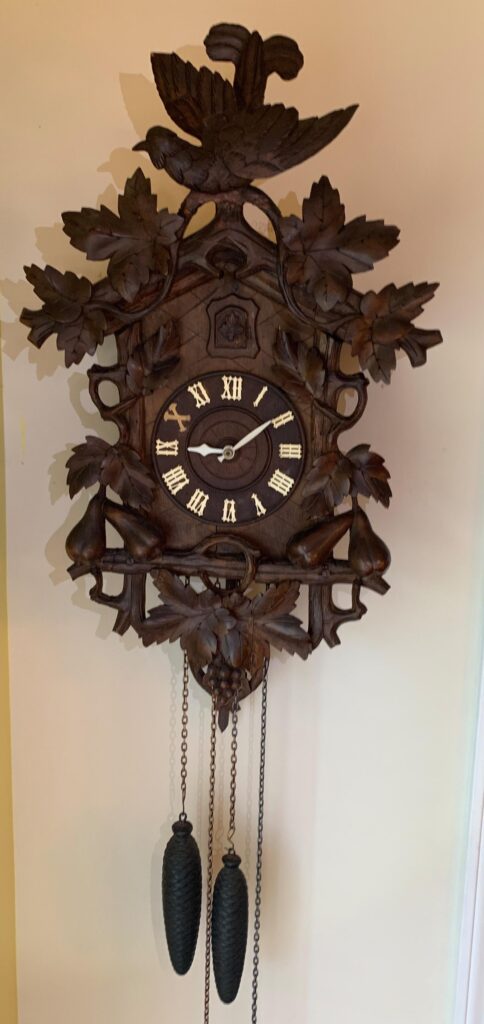
Recently, someone in a cuckoo clock Facebook group asked for help identifying a clock they had acquired. It was a traditional carved cuckoo clock with pears, grapes, vines/leaves, and a bird in a rather unique pose—stylized and different from typical catalog illustrations (Fig. 3).
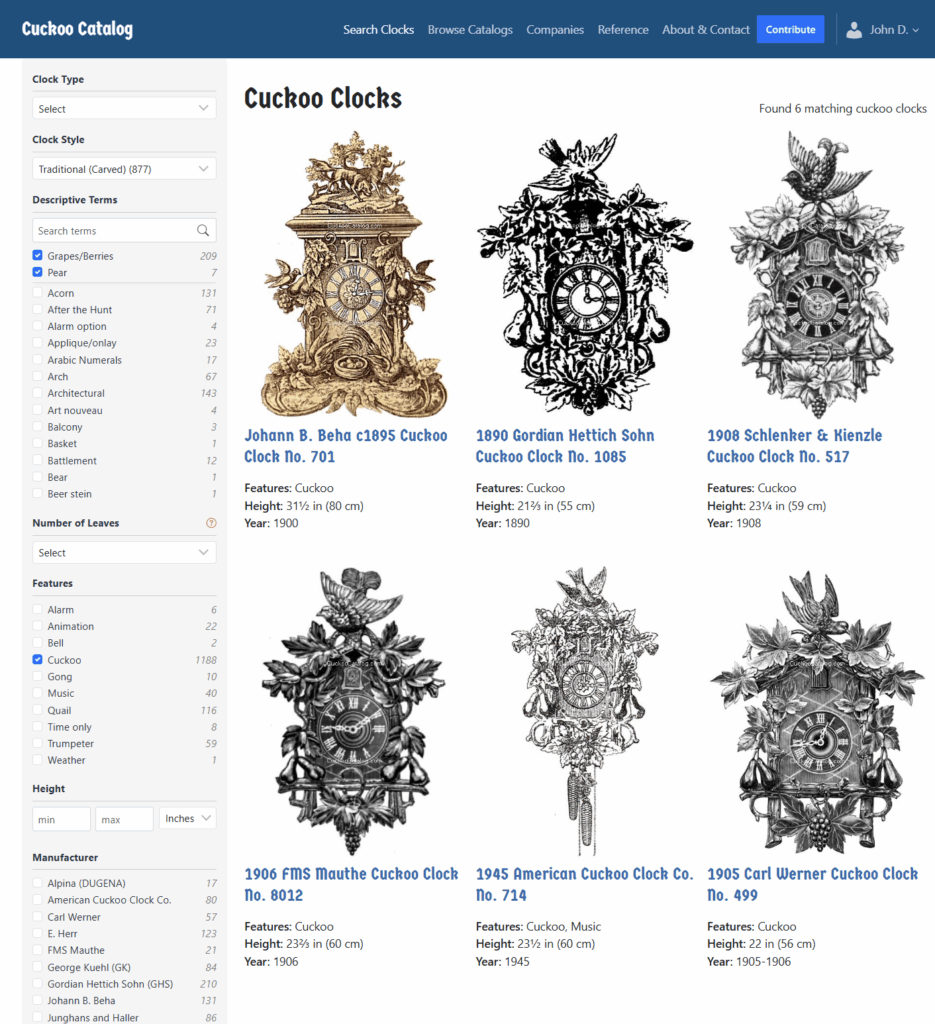
After entering the terms “pear,” “grapes,” and “bird” into the search function, the site filtered 45 catalog documents with over 1,200 cataloged clocks and returned only six results. Four were easily ruled out. The remaining two were excellent matches (Fig. 4):
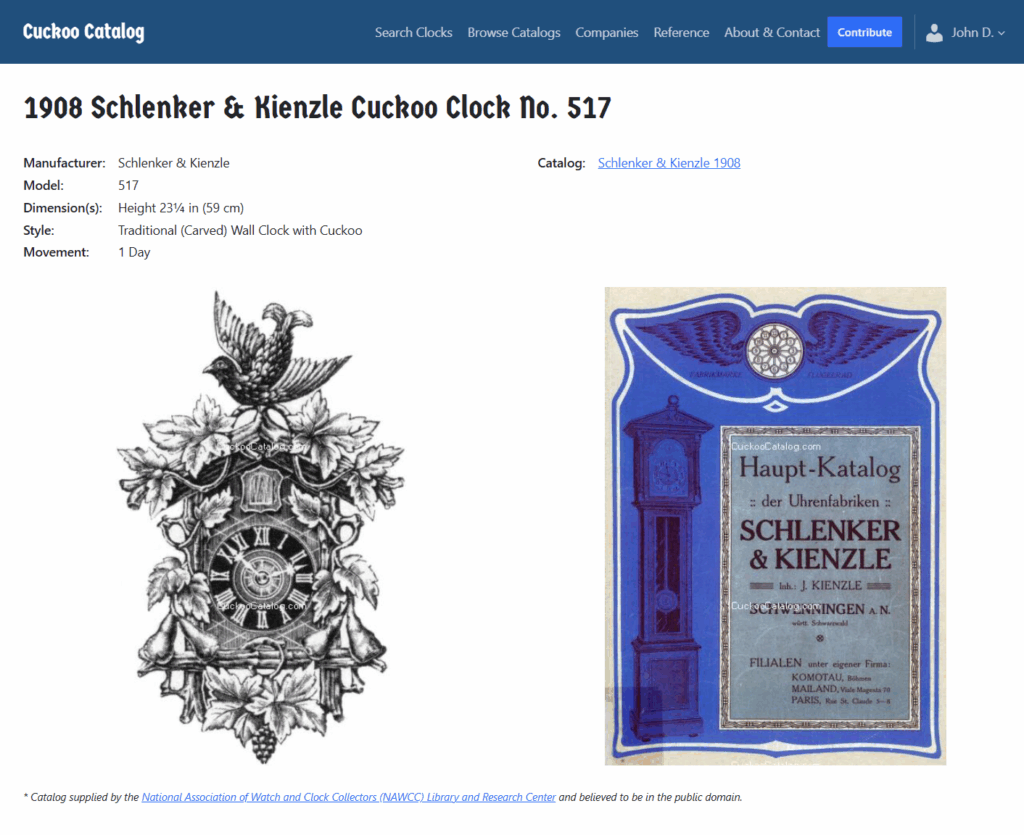
- Schlenker & Kienzle No. 517 from 1908
- Friedrich Mauthe No. 8012 from 1906
Clicking on one of the results displays a larger image of the catalog entry, the catalog cover and title pages, known dimensions, and any descriptive text from the original source (Fig. 5).
More Than Just a Search Tool
In addition to the search engine, users can also browse entire catalogs page by page and view each clock. About one-third of my collection is currently online, with a focus on offering the widest possible variety of manufacturers.
As the website expands, I plan to include catalogs from multiple years per manufacturer. This will help with dating unknown clocks by showing how long certain models were produced.
For example, the 1870 Philipp Haas & Söhne catalog is currently available online. I plan to supplement it with editions from 1880, 1890, and 1905. I also own several catalogs from other manufacturers like Gordian Hettich and Junghans-Haller, which will be added in due course.
User Contributions and Features
The site already allows users to upload their own photos of their clocks. This is especially helpful when catalog illustrations are inaccurate or stylized and don’t reflect the actual appearance of the clock. These contributions enrich the reference archive with real-world examples and provide better insight into details like pendulums or ornaments that are often missing, damaged, or—like pendulums—not shown in catalog illustrations.
CuckooCatalog.com also offers educational resources, including:
- Guides for buying replacement parts
- Basic repair instructions, such as replacing the leather on cuckoo bellows
Preserving Black Forest Heritage
The Black Forest region in Germany holds a legendary place in clockmaking history. Cuckoo clocks—especially the hand-carved models from towns like Triberg, Furtwangen, and Schönwald—represent not only fine craftsmanship, but also cultural identity and innovation.
Each clock tells its own story: of local artisans, family-run workshops, regional styles, and changing tastes over the decades. Unfortunately, much of this heritage is at risk of being lost as manufacturers close, archives are discarded, and generational knowledge fades.
This is why projects like CuckooCatalog.com are so important. By collecting, preserving, and making these catalogs publicly accessible, we are documenting a delicate piece of horological and cultural history. Every scanned page, every model number, every depicted cuckoo contributes to the comprehensive documentation of Black Forest ingenuity.
This is not just about clocks—it’s about preserving the voices and visions of the people who created them.
How You Can Help
To support the growth of this project, I’ve outlined a few ways clock enthusiasts can contribute:
- Donate or scan old catalogs to expand the archive
- Help secure reproduction permissions for catalogs, especially newer ones still under copyright. I’ve collected many catalogs from the mid-20th century and later, but due to copyright protection, their images can’t be published without permission. Help is often needed in identifying relevant information such as the manufacturer’s life dates, possible family heirs, or current business successors who may hold the rights. If you have access to genealogical records, historical directories, or personal connections to clockmaker families, this information can be very helpful in securing rights for historically valuable catalogs.
- Provide financial support to cover the technical, legal, and operational costs of the project. Running CuckooCatalog.com requires a variety of resources beyond time and effort. Financial contributions help fund web hosting, specialized software, high-resolution scanning equipment, legal assistance with copyright issues, and the acquisition of rare catalogs from auctions, dealers, and private collections. Every donation—no matter the amount—makes a meaningful contribution to preserving this horological heritage and making it publicly available.
You can find more details on how you can help on our Contribute page.
Acknowledgments
Special thanks to Dr. Bernhard Huber of the Deutsche Gesellschaft für Chronometrie (DGC) in Nuremberg, Germany, and Thomas Stocker, librarian at the National Association of Watch and Clock Collectors (NAWCC) in Columbia, Pennsylvania, USA. Their dedication to preserving horological literature and historical company catalogs has been invaluable to the development of this project and the broader effort to document the rich history of cuckoo clockmaking.